

Glossary
Alphabetical list of terms in a particular domain of knowledge with the definitions for those terms.
Asset
Addressable digital property or entity.
Example:
1. Blockchain Token
2. Copyrighted Digital Work
3. Domain, Username & Digital Identity
Asset Storage
Digital location of an asset:
1. Offchain: Asset(s) may be stored in a centralized server.
2. Onchain: Asset(s) stored as transaction on a decentralized ledger.
Blockchain
A system in which a record of transactions are maintained across several computers that are linked in a peer-to-peer network.
Collection
A group of assets.
Crypto Collectible
- An ownable and transferrable immutable cryptographic asset
- An immutable decentralized ledger dataset or entry that can be assigned an ownership and has transfer function
Example: ERC-20 Token, ERC-721 Token, Blockchain Identity (Namecoin & ENS).
Curated Collection
A group of cryptographic collectibles or assets that are procedurally regulated or curated.
Deployment
Method of which an asset is deployed or inserted into a blockchain.
Example: Manual Minting or Registration, Decentralized App, Smart Contract.
Development State
Current state of an asset or crypto collectible.
Example: Active development, or Inactive development.
Divisible
A supply state in which semi-fungible cryptographic collectible or asset is fractionalized into arbitrary share of ownership.
Example: 1000 supply of FDCARD (Spells of Genesis) is divisible into 0.0001% share of ownership instead of 1/1000 ownership.
Edition
The total number of semi-fungible asset within a collection.
Global Supply
An unregulated or uncurated supply state of crypto asset:
1. Uncurated: Supply state of an asset presented as-is. (Example: CryptoPunks global supply is 10,000).
2. Curated: Supply state of an asset with parameters. (Example: 1,500 CryptoPunks minted in 2017).
Mintable
A state of cryptographic collectible or asset with an active or inactive deployment or issuance, possibly affecting its supply count.
Native Function
An executable command or line of codes in regards to cryptographic collectible or asset that existed or written since its deployment or issuance. A wrapper is not considered a native function.
Non-Fungible
A unique digital entity that aren’t equally interchangeable.
Example: Digital Fingerprint such as MD5 hash, or Non-Fungible Token.
Offchain Name
Name or title of a particular asset or collection that exist outside of the blockchain. Example: Social recognition or general consensus.
Onchain Name
Name or title of a particular asset or collection that exist in the blockchain hard-coded inside a smart contract.
Pre-ERC721 Supply
A regulated or curated supply state of assets within April 21, 2011 (First Crypto Asset minted on Namecoin -> d/bitcoin) to March 19, 2018 (Genesis of Non-fungible Token Standard).
Primary Asset
Refers to the token which today is identified by _tokenID (in ERC-721) or Name (in Namecoin) that is precursor to ERC-721.
Secondary Asset
Refers to anything that the identified token is embedding or linking, such as Metadata (JSON), Files (JPEG, GIF), and URLs.
Semi-Fungible
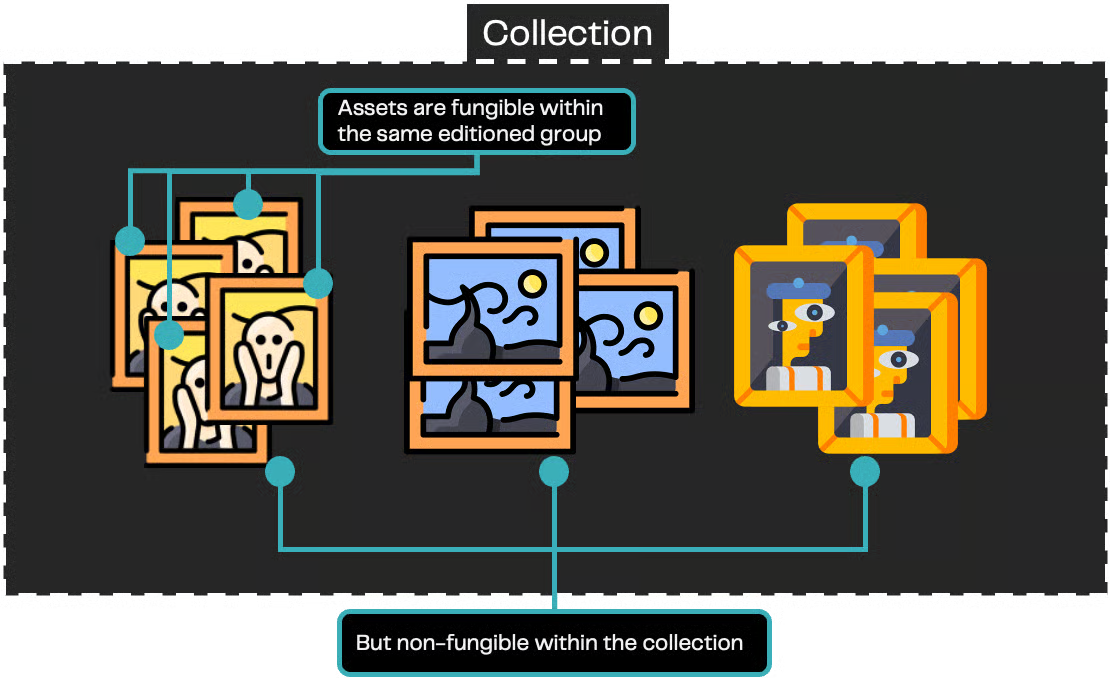
Digital entities that are equally interchangeable within the same edition, but not equally interchangeable within or outside of a collection.
Illustration by @Chainleft. Source: Mirror.xyz
Token
An Identifiable (Explorable), Addressable (Ownable and Transferrable) blockchain entry.
Version
A state in which a crypto asset may have multiple variations.
Example: Etheria v0.9, v1.0, v1.1, v.1.2 & CryptoPunks v1 & v2.
Archival Record curated by OLDNFT.com. Definitions based on historical technical standards.