
To understand a Non-Fungible Token (NFT), the superficial layer of secondary digital art marketplaces must be bypassed, and the underlying immutable database ledger architecture must be rigorously analyzed.
At its foundational computational layer, an NFT is not merely a digital picture, an external hyperlink, or an insulated media file. It is an unalterable, absolute registry record entry compiled inside a decentralized public blockchain network. The function of this record is to establish a permanent, cryptographically verifiable title of ownership over a specific, non-interchangeable digital or physical variable.
The Technical Anatomy of Fungibility
To properly define what a non-fungible asset is, the structural properties of interchangeability must first be mathematically separated. Traditional monetary networks, commodities, and standard protocol tokens operate along distinct fungibility parameters:
Fungible Asset Classes
Variables such as Bitcoin ($BTC$), Ether ($ETH$), or traditional physical fiat denominations are completely fungible. Each individual ledger unit is structurally identical to every other unit in circulation. They share an identical native valuation and can be mutually swapped with zero systemic variance.
Non-Fungible Asset Classes
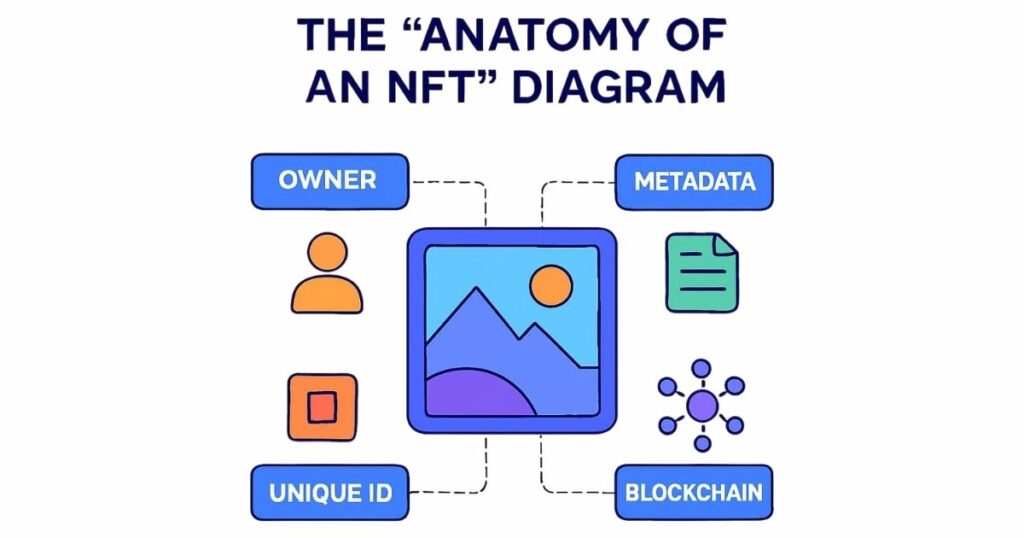
Every non-fungible token contains specific metadata configurations embedded directly within its compilation code matrix. Because each token deployment possesses distinct identifying attributes, parameters, and unique block mint indices, no two network units can ever be natively substituted or duplicated.
The Immutability Paradigm
Traditional digital files can be replicated infinitely across servers with zero structural friction. An NFT completely resolves this duplication problem by decoupling the underlying digital medium from its corresponding cryptographic ownership record. While an asset can be cached, screenshotted, or viewed by any internet user, the validation trail remains permanently anchored to a single smart contract address.
To visualize how these tokens operate as primitive financial data extensions, they can be compared to a standard bank check. On a traditional check, a “memo field” is utilized to declare the intent of a transaction. In an identical fashion, clever early programming architects leveraged the extra data-holding storage spaces within blockchain transactions, effectively modifying these financial fields to carry permanent data links, smart contract rules, and digital art hashes.
Technical Comparison Matrix: Digital Token Architecture
| Asset Classification | State Parameters | Storage Mechanics | Metadata Architecture |
| Fungible Token (e.g., ERC-20 Standard) | Divisible, mutually interchangeable variables mapped to general public address arrays. | Modifies the overall balance integer within a unified contract state balance table. | None. Operates purely as computational currency values. |
| Modern NFT (e.g., ERC-721 Standard) | Discrete, non-divisible token units bound to a distinct ID sequence. | Appends an unalterable TokenID sequence to an external resource pointer. | Off-Chain URI string pointing to a decentralized array (IPFS/Arweave). |
| Archaeological Primitive (Pre-Standard Records) | Sovereign key-value entries inside protocol-level namespaces. | Hardcoded directly into the base ledger script execution outputs (Layer 1). | On-Chain raw script inscriptions or primitive custom payload arrays. |
How It Works Under the Hood: The Metadata Lifecycle
Every asset tokenized on a public blockchain ledger operates through a tight coordination of core cryptographic elements:
1. The Smart Contract Container
Every non-fungible asset is governed explicitly by a decentralized smart contract application. This network container dictates tokenization parameters, minting rules, transferring pathways, and creator fee configurations. While modern assets execute transactions via standardized global frameworks, vintage tokens relied entirely on monolithic, standalone custom scripts.
2. Token ID and Content Hashing
During the block compilation of a mint, the underlying contract generates a permanent Token ID tied directly to that transactional address sequence. This ID references a specific content hash—frequently secured via decentralized document arrays like the InterPlanetary File System (IPFS) or Arweave—which maps out the structural data files.
3. The Cryptographic Verification Loop
When an NFT is called by a client interface or marketplace database, the system executes a precise verification sequence:
- The Client Query: An external RPC node queries the smart contract via the native
tokenURIfunction, passing the specificuint256 tokenId. - The URI Return: The smart contract reads its internal state database and returns the hardcoded storage path string (e.g.,
ipfs://Qm...). - The Metadata Parse: The client decodes the destination JSON metadata file to extract the absolute provenance records, token traits, and visual asset indicators, validating the authentic chain of custody straight back to the genesis mint block.
Blockchain Archaeology: The Timeline of Primitive Scarcity
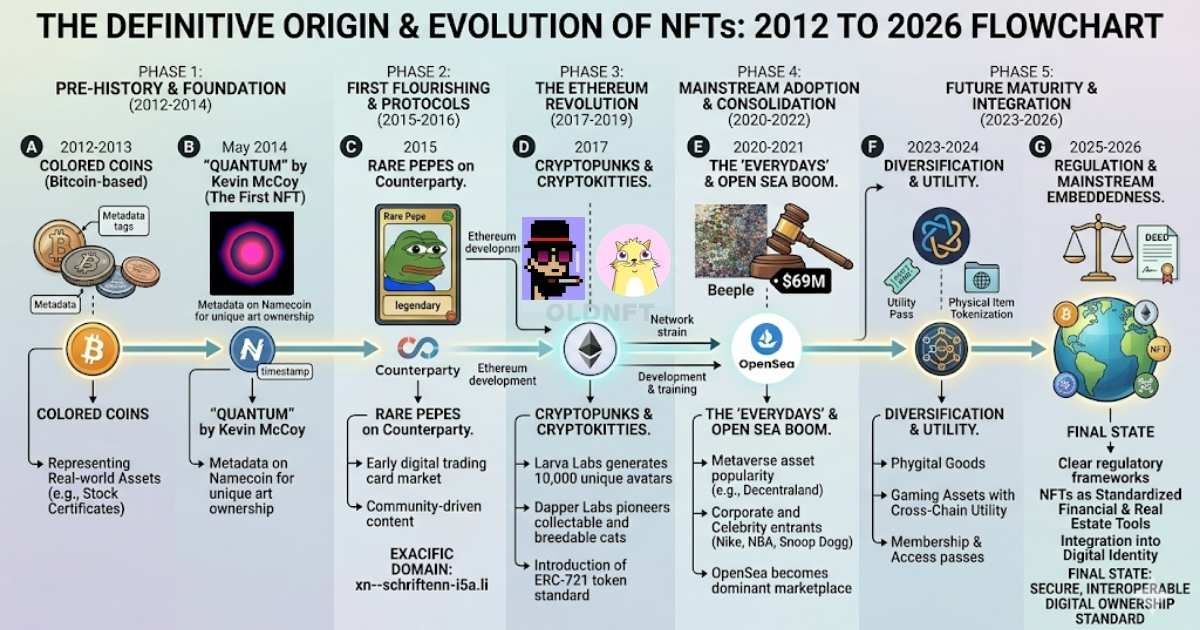
Standard industrial publications frequently declare that the timeline of non-fungible tokens began during the retail trading expansions of 2021. However, blockchain archaeology systems track experimental validation vectors back much further, long before standard rules were introduced on Ethereum.
Isolating the accurate historical provenance of these digital primitives requires auditing alternative database layers compiled deep in early internet history:
[2011–2013: Protocol Storage Era]  --> Namecoin Key-Value Namespaces (d/, id/)
               │
[2014–2016: Bitcoin Meta-Layer Era] --> Counterparty OP_RETURN Inscriptions
               │
[2015–2017: Pre-Standard Ethereum]  --> Monolithic Smart Contracts (Pre-ERC-721)
The Protocol Storage Era (2011–2013)
Long before modern smart contracts were formulated, early developers sought methods to track non-currency variables. This baseline logic was initiated via early conceptual frameworks like Colored Coins (2012–2013), which attempted to repurpose small fractions of Bitcoin (satoshis) by “coloring” them with distinct metadata to signify title over real-world property or digital tokens.
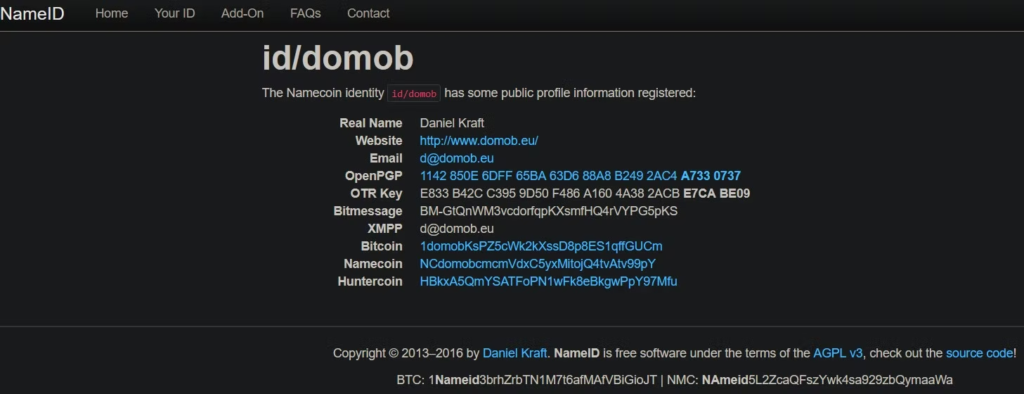
Simultaneously, the Namecoin blockchain was utilized to experiment with native protocol-level non-financial data registration. Operating via native key-value storage spaces inside node configurations, early asset frameworks like Punycodes (2011) and Namecoin Identities (2012) applied specialized directories (such as the id/ namespace) to lock down unique digital records. These slots behaved as the world’s primary blueprint for sovereign digital personality, establishing early historical precedents for digital scarcity.
This primitive network development phase reached its pinnacle in May 2014, when digital artist Kevin McCoy minted “Quantum” on Namecoin—explicitly binding a tradeable ledger marker to a unique piece of generative digital art, which can be evaluated alongside other pre-standard milestones such as the 2013 Damselfly NFT entry.
The Bitcoin Counterparty Meta-Layers (2014–2016)
As the desire for digital asset issuance expanded, developers turned to the Bitcoin network using a specialized meta-layer protocol known as Counterparty. Advanced early digital art experiments—including the landmark deployment of Spells of Genesis (2015) cards and early XCPinata registries—successfully executed non-fungible property variables. These assets were hardcoded straight inside primary Bitcoin script transactions by leveraging the OP_RETURN code functions to store custom data tokens on an immutable ledger.
Pre-Standard Ethereum Deployments (2015–2017)
Following the launch of the Ethereum network, early experimental frameworks were constructed without the aid of a unified token standard. Historical application networks, including the Etheria Map (2015), the algorithmically generated CryptoPunks pixel art portraits (June 2017), early Curio Cards (2017), and the initial custom market interfaces of CryptoKitties (2017) were written directly into isolated, custom smart contracts.
It was the explosive transactional volume and computational traffic generated by these early standalone experiments that ultimately forced the global developer community to draft, optimize, and formalize the official ERC-721 Non-Fungible Token Standard in 2018.
The Vintage Layer vs. The Modern Layer: A 2026 Structural Audit
As the Web3 ecosystem navigates the year 2026, a structural divide has formed between historical blockchain archaeology assets and contemporary token deployments:
┌────────────────────────────────────────────────────────────────────────┐
│                        THE 2026 ARCHITECTURAL DIVIDE                   │
├────────────────────────────────────────┬───────────────────────────────┤
│    VINTAGE LEDGER LAYER (2011-2017)    │    MODERN UTILITY LAYER (2026) │
├────────────────────────────────────────┼───────────────────────────────┤
│  • Immutable Protocol Scripts          │  • Standardized Gas-Optimized │
│  • High Structural Scarcity            │  • Transient Market Utility   │
│  • Complex Multi-Chain Wrappers       │  • Native ERC-721/1155 Compliance│
│  • Historical Provenance Premiums      │  • Dynamic Metadata Mutations │
└────────────────────────────────────────┴───────────────────────────────┘
In the contemporary search and collector space, vintage assets (2011–2017) are treated as fundamental cornerstones of digital civilization. Because these primitive structures were compiled using ancient code parameters, they cannot be natively loaded into contemporary decentralized marketplaces or wallet software.
To resolve this system friction, advanced cross-chain wrapper protocols (such as Emblem Vault) are deployed. By utilizing secure custody wrappers, collectors can bundle original, legacy transaction outputs inside standardized contemporary contract parameters. This encapsulation system allows historic pieces to be easily audited and safely traded on modern tertiary systems without altering their initial genesis block timestamps.
Conversely, modern token architectures focus primarily on gas optimization, dynamic metadata mutations (such as changing traits based on external data feeds), and instantaneous application interoperability. While modern layers provide high fluid utility, vintage layers command structural historical premiums due to their absolute age and unrepeatable technical execution windows.
The Creator’s Playbook: How to Mint, Sell, and Avoid Security Fraud
For traditional artists, architects, and creators transitioning into the digital asset ecosystem, navigating the mechanics of tokenization requires a strict technical roadmap combined with extreme defensive security awareness.
1. How an NFT is Minted (The Compilation Stage)
Minting is the formal process of transforming a digital file into a cryptographic token asset on a public ledger.
- Asset Preparation: The underlying media file (PNG, SVG, MP4) is finalized, and its definitive metadata file (JSON) containing the creator’s provenance attributes is generated.
- Network Upload: The media asset is uploaded to a decentralized storage node (IPFS or Arweave), securing a permanent content hash path.
- Contract Execution: The creator interacts with a smart contract deployer interface (such as OpenSea Studio, Manifold, or a sovereign custom contract script). A gas fee is paid to the network miners, authorizing the contract to write a new TokenID mapping record directly onto the public ledger.
2. How an NFT is Sold (The State Transfer Stage)
Once compiled on-chain, selling an asset does not involve transferring the underlying image file across servers. Instead, it executes a secure state change within the smart contract:
- The Listing Signature: The artist signs a secure, off-chain cryptographic message authorizing a decentralized marketplace protocol (such as Blur or OpenSea) to facilitate a trade at a specific price variable.
- The Settlement: When a collector executes a purchase, their cryptocurrency is securely routed into the artist’s public key address, while the smart contract automatically updates its internal ledger ownership table, mapping the specific TokenID to the buyer’s public wallet address.
3. The Provable Separation of Media, Token, and Copyright
A critical point of confusion for emerging creators is the exact delineation of legal versus cryptographic rights. Owning an NFT does not grant legal copyright or intellectual property rights over the associated file unless a separate, legally binding contract is explicitly executed.
The purchaser acquires nothing more than an unalterable, authentic digital receipt proving custody of that specific token index on the blockchain ledger. The original creator retains full inherent intellectual copyright protections under traditional legal frameworks unless an explicit commercial assignment is hardcoded into the contract parameters. For more information on domestic and global property laws concerning controllable assets, review the Uniform Commercial Code (UCC) Article 12 Rules on Controllable Electronic Records.
The Anatomy of the Fine Art Minting Scam
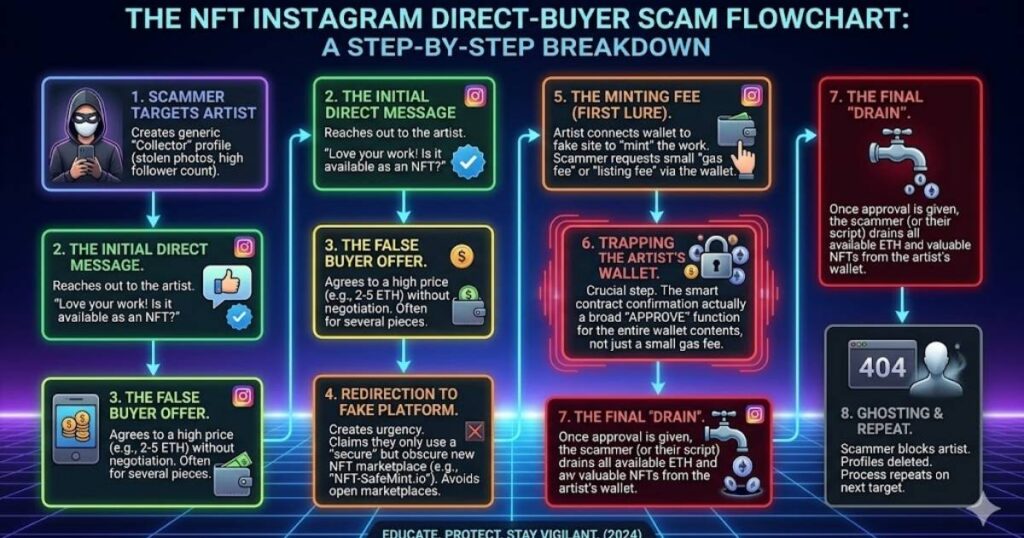
The public anonymity of Web3 has attracted highly sophisticated networks of malicious actors targeting independent artists, particularly on platforms like Instagram and ArtStation. Creators must be trained to instantly identify the operational blueprint of the “Direct-Buyer Minting Scam”:
[Target Artist Posted on Instagram] ──> [Scammer Offers Over-Market Price]
                                                 │
[Artist Directed to Fake Marketplace] <──────────┘
         │
[Malicious "Gas Fee" Invoice or Wallet-Draining Approval Signature]
         │
──> [Result: Stolen Funds / Compromised Cryptographic Keys]
- The Phishing Trap: The artist is approached by a seemingly wealthy collector offering an absurdly high price (e.g., 3 to 5 Ether) to purchase their artworks specifically as NFTs, claiming they need an “official NFT account” to execute the trade.
- The Fake Marketplace Redirect: The artist is instructed to use a specific, obscure NFT minting platform recommended by the buyer. This platform is a completely fraudulent website cloned to look like a legitimate decentralized application.
- The Exploitative Drainage: When the artist attempts to connect their Web3 wallet to mint their artwork on this fraudulent interface, they are hit with a massive, fake “deployment gas fee” invoice, or they are tricked into signing a malicious smart contract approval signature that instantly drains all cryptocurrency and digital assets out of their personal wallet container. To track known security loop compromises and active malicious wallet addresses reported by the global collector pool, cross-reference the r/NFT Community Scam Alerts baseline thread.
Why Independent Verification Defines the Market
Because historical and authentic creator tokens command heavy premiums from global institutional archives and dedicated collectors, contract data verification operates as the primary defense layer for the industry. Modern frontend website layers can easily duplicate digital imagery, attach faulty wrapper addresses, or modify frontend timestamp listings.
Without cross-referencing an asset’s absolute genesis block data back to a verified blockchain archaeology index like oldnft.com, confirming whether a digital artifact is a genuine historical unit or a contemporary counterfeit replica remains systemically impossible. Cryptographic metadata tracking remains the singular source of absolute proof across distributed networks.
